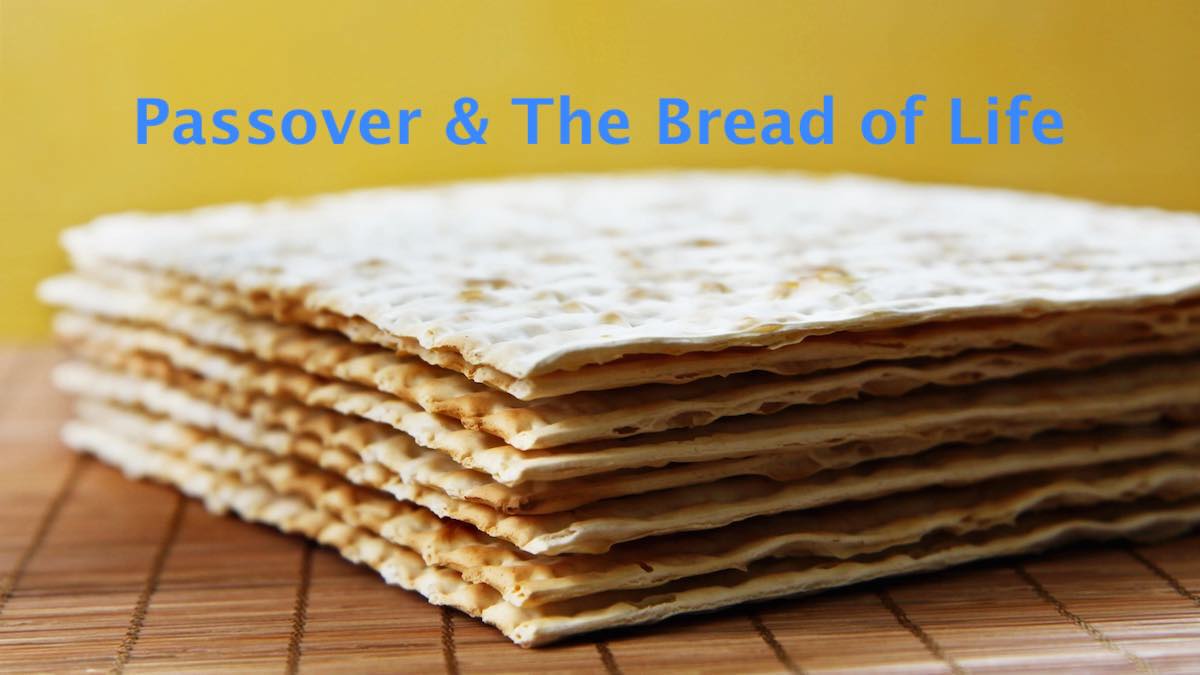
This year (2026) Passover begins on Wednesday evening, April 1st. As I prepare to celebrate Passover in Jerusalem, I was reflecting on Yeshua’s words when He said, “I am the bread of life.” (John 6:48 – NASB)
-
What was Yeshua communicating when He declared, “I am the bread of life”?
-
Is there a connection between these words of Yeshua to Passover?
-
What was the context in which Yeshua made this statement?
John chapter six is a very long chapter containing 71 verses; however, the events detailed in it occurred over just two days. The context of John 6 is described for us in the first few verses of this chapter:
1 After these things Yeshua went away to the other side of the Sea of Galilee (or Tiberias). 2 A large crowd was following Him, because they were watching the signs which He was performing on those who were sick. 3 But Yeshua went up on the mountain, and there He sat with His disciples. 4 Now the Passover, the feast of the Jews, was near. 5 So Yeshua, after raising His eyes and seeing that a large crowd was coming to Him, said to Philip, “Where are we to buy bread so that these people may eat?” (John 6:1-5 – NASB)
Geographically, Yeshua and His disciples were in the north of Israel around the Sea of Galilee. We also read that it was during the season of spring as the Feast of Passover was near or soon approaching. Passover was the context and the majority of events in this chapter center on the significance of this biblical feast.
Crowds of people were following Yeshua because of the miracles that He was performing. It was as a result of these large crowds that Yeshua asked Philip where they could buy bread for the people. Philip then asked the question, “Where are we to buy bread so that these people may eat?” It was not only a question of the large quantity of bread needed to feed the crowds of people but, as they were approaching the time of Passover, regular bread would be difficult to find. In the days leading up to Passover, the Jewish people would have been cleaning out the leavened items from their homes and communities as Passover is intrinsically connected to the Feast of Unleavened Bread. The major event that immediately followed Philip’s question is what is known as the feeding of the 5,000: Yeshua took five loaves of bread and two fish from a boy in the crowd and fed all of the people with 12 baskets full of bread leftover (John 6:6-14).
The Bread Chapter
It is easy to compartmentalize the events recorded for us in the Bible while sometimes missing the bigger picture. For example, one could focus on the miracle that Yeshua performed by taking five barley loaves and two fish and fully satisfying the food needs of over 5,000 men to the exclusion of the dialogue that Yeshua had with the people the very next day. Continuing in John 6, however, we see how the subject of “bread” is a major focus until the end of the chapter.
Despite Yeshua’s best efforts to avoid the crowds, they chased after Him and eventually caught up to Him the next day on the other side of the Sea of Galilee:
25 And when they found Him on the other side of the sea, they said to Him, “Rabbi, when did You get here?” 26 Yeshua answered them and said, “Truly, truly, I say to you, you seek Me, not because you saw signs, but because you ate some of the loaves and were filled. 27 Do not work for the food that perishes, but for the food that lasts for eternal life, which the Son of Man will give you, for on Him the Father, God, has set His seal.” 28 Therefore they said to Him, “What are we to do, so that we may accomplish the works of God?” 29 Yeshua answered and said to them, “This is the work of God, that you believe in Him whom He has sent.” 30 So they said to Him, “What then are You doing as a sign, so that we may see, and believe You? What work are You performing? 31 Our fathers ate the manna in the wilderness; as it is written: ‘He gave them bread out of heaven to eat.’” 32 Yeshua then said to them, “Truly, truly, I say to you, it is not Moses who has given you the bread out of heaven, but it is My Father who gives you the true bread out of heaven. 33 For the bread of God is that which comes down out of heaven and gives life to the world.” 34 Then they said to Him, “Lord, always give us this bread.”
35 Yeshua said to them, “I am the bread of life; the one who comes to Me will not be hungry, and the one who believes in Me will never be thirsty. 36 But I said to you that you have indeed seen Me, and yet you do not believe.” (John 6:25-36 – NASB)
Such a fascinating dialogue! Instead of answering the question that the crowd asked Him regarding when He arrived, Yeshua said that the only reason they were seeking Him was because of the loaves of bread they ate (John 6:26). We then read the word “bread” six more times just in the verses quoted above. Yeshua tried to challenge the people to seek the eternal gift of God which is found in the Son of Man but the people could not break free from their quest for physical bread.
When the people understood that He was telling them that He is the Son of Man who was sent from heaven, they asked for a sign like “the manna in the wilderness” (John 6:31). Yeshua kept trying to get the people to see that something greater than manna from heaven was in their midst. He then declared for the first time, “I am the bread of life” (John 6:35).
-
What was Yeshua communicating when He made this statement about being “the bread of life”?
I believe it is clear from the context that Yeshua was taking the basic function of bread as a source of sustaining human life and declaring that He was and is the source of spiritual life, eternal life. He stated this plainly in verse 27, “Do not work for the food that perishes, but for the food that lasts for eternal life, which the Son of Man will give you, for on Him the Father, God, has set His seal.”
Yeshua attempted to convince the crowds of people that He indeed was the Son of Man whom the Father in heaven sent into the world and that those who believed in Him would be granted eternal life. Yeshua declared that He was the spiritual provision (bread) of God which was available to all people.
-
Was Yeshua’s statement declaring “I am the bread of life” simply metaphorical or was it to be taken literally?
I believe that most people who read John 6 would understand Yeshua’s declaration of being “the bread of life” to be metaphorical; however, we read Yeshua’s continued dialogue with the people a few verses later and we must reconsider:
47 “Truly, truly, I say to you, the one who believes has eternal life. 48 I am the bread of life. 49 Your fathers ate the manna in the wilderness, and they died. 50 This is the bread that comes down out of heaven, so that anyone may eat from it and not die. 51 I am the living bread that came down out of heaven; if anyone eats from this bread, he will live forever; and the bread which I will give for the life of the world also is My flesh.” 52 Then the Jews began to argue with one another, saying, “How can this Man give us His flesh to eat?” 53 So Yeshua said to them, “Truly, truly, I say to you, unless you eat the flesh of the Son of Man and drink His blood, you have no life in yourselves. 54 The one who eats My flesh and drinks My blood has eternal life, and I will raise him up on the last day. 55 For My flesh is true food, and My blood is true drink. 56 The one who eats My flesh and drinks My blood remains in Me, and I in him. 57 Just as the living Father sent Me, and I live because of the Father, the one who eats Me, he also will live because of Me. 58 This is the bread that came down out of heaven, not as the fathers ate and died; the one who eats this bread will live forever.” (John 6:47-58 – NASB)
Yeshua spoke in a straight forward and direct manner regarding being the “living bread” which came down out of heaven. He also proclaimed that those who want to live forever must eat His flesh and drink His blood (John 6:53-55).
-
How can we make sense of Yeshua’s words as recorded in John 6?
-
Did Yeshua really expect the crowds of people to eat His flesh and drink His blood?
If you are struggling to fully grasp Yeshua’s words, you are not alone. Some of His own disciples failed to understand what He was communicating at that time (John 6:60) and many of His disciples abandoned Him: “As a result of this many of His disciples left, and would no longer walk with Him.” (John 6:66). For those who appreciate numerology, the reference of “666” for this verse is a good reminder that it is not wise to walk away from Yeshua!
As we have the privilege today to read the New Testament in its fulness, I believe the answers to the above questions regarding eating His flesh and drinking His blood are best understood in the context of this chapter which occurred in the days leading up to the Feast of Passover (John 6:4). Although we know that it would be at least another year before the Passover when Yeshua ate the Last Supper with His disciples (John 13) and was crucified as the Lamb of God (John 19), the context in John 6 of the Passover informs us what Yeshua meant by the phrase, “The one who eats My flesh and drinks My blood has eternal life,…” (John 6:54).
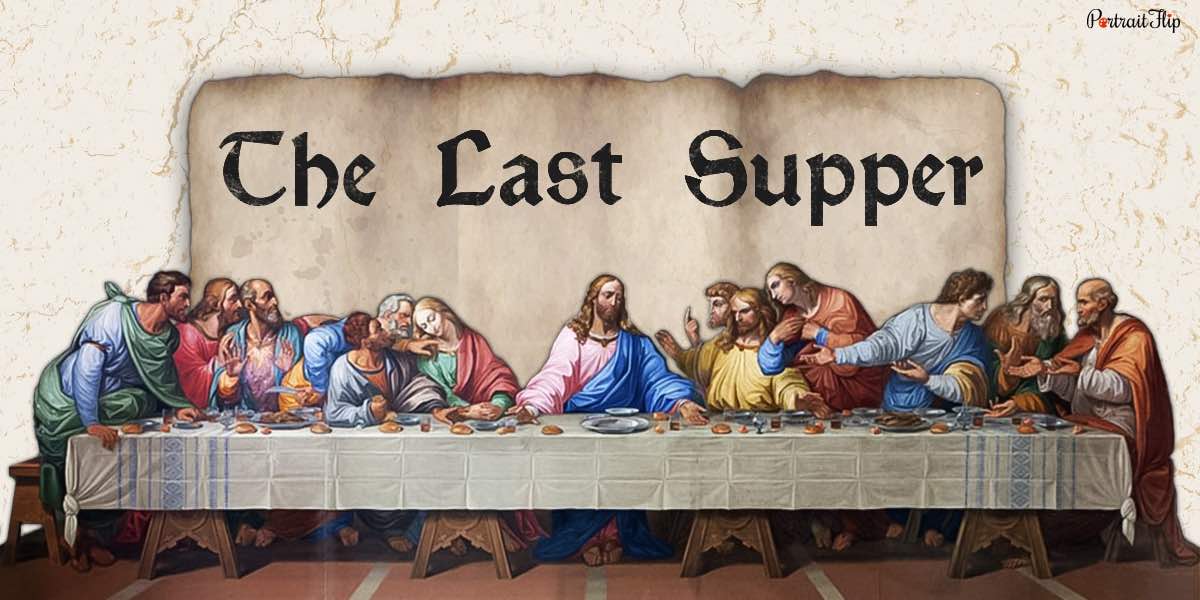
When Yeshua instituted the New Covenant on the evening of Passover He distinctly spoke of His body and blood in terms of the bread and wine used for the Feast of Passover, as we read in Matthew’s gospel:
26 Now while they were eating, Yeshua took some bread, and after a blessing, He broke it and gave it to the disciples, and said, “Take, eat; this is My body.” 27 And when He had taken a cup and given thanks, He gave it to them, saying, “Drink from it, all of you; 28 for this is My blood of the covenant, which is being poured out for many for forgiveness of sins. 29 But I say to you, I will not drink of this fruit of the vine from now on until that day when I drink it with you, new, in My Father’s kingdom.” (Matt. 26:26-29 – NASB)
The New Covenant was established during a traditional Passover Seder when lamb was still the main course eaten at the table and it was accompanied by unleavened bread (matzah) and four glasses of wine. For some reason, the New Testament does not use the term “matzah” or “unleavened bread” except when speaking distinctly about the “Feast of Unleavened Bread” or in a spiritualized concept in 1 Corinthians 5:7-8. However, we know that Yeshua used matzah, the unleavened bread at Passover, to represent His sinless body and that He took the cup of wine after the meal (most likely the third cup, the cup of redemption) to represent His blood which would be poured out on the cross in less than 24 hours from that Last Supper meal at Passover.
Excellent!! Thank you for placing these words of our Lord within their context.
Hallelujah! What a Savior!!
The Light of the World!
The Door of Entrance!!
The Good Shepherd!!
The Resurrection and the Life!!
The Way, the Truth and the Life!!
The True Vine!!
MAY YOU KNOW THE PEACE THAT PASSES ALL UNDERSTANDING AS YOU EXPERIENCE THE TERRORS ON THE RIGHT HAND AND LEFT HAND!!
We await your next report!!
Amen! Thank you Mike!
Daniel
I badly miss your Tuesday Morning studies in Genesis. I do not say this to make you feel bad, but to encourage you for your diligent labors.
Thanks Mike. Hopefully we will be able to resume one day soon.
Daniel I got on my knees and again prayed for your safety.
Thanks so much for continuing to teach us the picture of CHRIST, in the PASSOVER.
I loved your message on JESUS OUR BREAD OF LIFE. He definitely is to me!!!
Love and continued prayers.
Bobbie and the GCC Intercessors.
Thank you Bobbie